
 English
 عربي
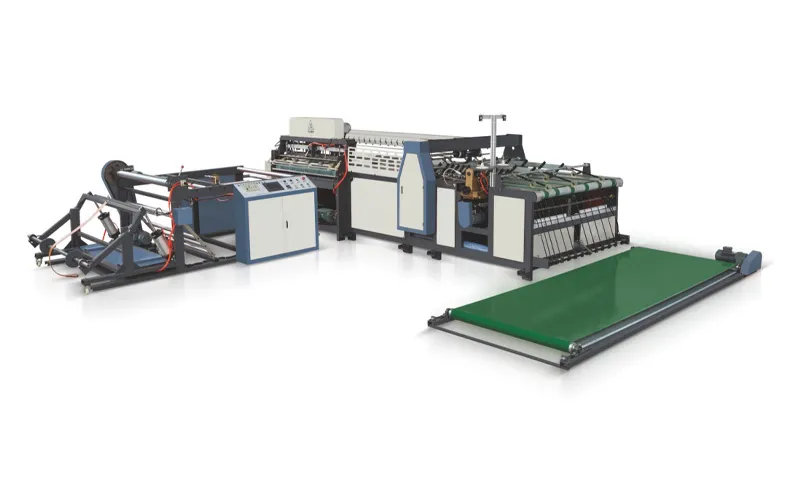
عربي Walk into any facility that produces cement bags, feed sacks or fertilizer bags. Chances are you’ll see a line of workers manually cutting woven fabric, folding the hem, and running each piece through a sewing machine. A Woven Bag Making Machine changes all of that. It‘s a fully automated system that takes a roll of PP woven fabric and produces finished bags — cut, sewn, and stacked — without anyone touching the material in between. Some models even print directly on the fabric before cutting. This guide explains the basic principle behind these machines, how they compare to manual production, and what makes Guoran’s version different.
From fabric roll to finished bag — no hands in between
The process starts with a large roll of tubular woven polypropylene fabric, supplied in widths up to 1200mm and roll diameters up to 1100mm.
Here‘s what happens next:
-
Fabric unwinds from the roll under controlled tension.
-
Cutting unit severs the tube at programmed intervals, typically between 550 and 1300mm.
-
Bottom folding mechanism folds the cut edge to form the bag’s hem.
-
Sewing head stitches the fold with a double chain stitch or overlock seam.
-
Optional printer applies date codes, weight markings, or branding on the fly.
-
Stacker collects finished bags into neat piles for palletizing.
All of this happens continuously at speeds from 23 to 45 bags per minute, depending on bag size. The entire sequence is orchestrated by a PLC with a touchscreen panel for operator control.
Why integrate what used to be separate
Traditional woven bag production is a fragmented process. A roll of tubular fabric moves to a cutting table, where an operator measures and cuts each bag manually. The cut pieces move to another station for hem folding. Then to a sewing operator. Then to a stacker. Each transfer introduces alignment errors, and every manual step caps throughput at 10–15 bags per minute on a good day.
An all-in-one machine eliminates those handoffs. Cutting accuracy is held by servo-controlled length measurement, not a tape measure. The fold is mechanically consistent, not dependent on operator skill. The seam is machine-sewn with identical stitch density on every bag.
Guoran‘s machine uses an integrated inspection system that checks raw materials with a German spectrometer, verifies key component dimensions to 0.005mm accuracy during production, and runs a full 120-hour factory test — including 48 hours of no‑load operation and 72 hours of full-load production — before any machine ships.
How fast, how wide, how precise
| Specification | GRQF800-1300 Model | GRQFY800-1300 Model |
|---|---|---|
| Bag width range | 450–800mm | 450–800mm |
| Bag length range | 550–1300mm | 550–1300mm |
| Max roll diameter | 1100mm | 1100mm |
| Max roll width | 1200mm | 1200mm |
| Production speed | 23–60 bags/min | 23–45 bags/min |
| Printing capability | No | Yes (all‑in‑one) |
The GRQF800-1300 is the faster model, reaching up to 60 bags per minute at smaller lengths. The GRQFY800-1300 adds an integrated printing station for converting printed fabric rolls into finished, printed bags in a single pass — eliminating a separate printing step.
What operators actually ask about woven bag machines
Does one person really run the whole machine?
Yes. The automated system handles cutting, sewing and stacking continuously. Guoran states that their integrated touchscreen and automatic counting reduce labor requirements by 50% compared to traditional methods. One trained operator can monitor multiple machines.
What happens if the thread breaks or the fabric runs out?
The machine includes line-break detection that stops the line immediately and alerts the operator via the touchscreen panel. The unwind stand also includes low-roll sensing, so you never run the machine dry.
Can the same machine handle different bag sizes?
Yes. The PLC stores recipes for different bag dimensions. Switching from a 600mm to a 1200mm bag takes less than five minutes — change the cut length in the controller, adjust the width guides, and you‘re running.
How does Guoran ensure reliability before shipping?
Every machine undergoes a 120-hour factory acceptance test, including 48 hours of no-load axis motion verification and 72 hours of full-load production using the customer’s specified raw materials. Metal components are tested with a German‑imported spectrometer for composition, and key parts are measured with a coordinate measuring instrument to 0.005mm dimensional accuracy. Dynamic spindle balance is held within 0.01mm deviation.
Beyond the machine — what the spec sheet doesn’t show
The mechanical specifications tell part of the story. But what keeps a woven bag line running year after year are the details underneath:
-
German spectrometer at the incoming inspection stage verifies alloy composition of every metal component. No subgrade steel enters the assembly process.
-
Coordinate measuring instrument checks critical mechanical parts to 0.005mm accuracy — roughly one‑twentieth the thickness of a human hair.
-
Full quality traceability through every production stage. If a part later fails in the field, the manufacturer can identify exactly when and on which machine it was processed.
-
On-site commissioning with the customer‘s own raw materials, plus operator training before handover.
Guoran also maintains lifelong equipment records and provides fast‑response spare parts support. For customers upgrading from manual lines, the company offers a 24‑hour continuous production verification during acceptance using their specified raw materials.
The two models Guoran offers
The Fully Automatic Woven Bag Cutting And Sewing Machine (GRQF800-1300) is the core model. It handles bag lengths from 550 to 1300mm, widths from 450 to 800mm, and runs at 23 to 60 bags per minute. This model is built for high‑volume converters who need pure cutting and sewing without the printing function.
The Fully Automatic Woven Bag Cutting, Sewing And Printing All‑in‑one Machine (GRQFY800-1300) adds a printing station that applies designs directly onto the moving fabric before cutting. It runs at 23 to 45 bags per minute — slightly slower than the non‑printing model, but eliminates a separate converting step.
Both machines share the same core components: servo‑driven feeding systems, PLC control with touchscreen, line‑break detection, and automatic counting and stacking.
Moving from manual to automatic — what changes
Switching from a manual cutting-and-sewing operation to a fully automatic woven bag making machine changes three things immediately.
Labor cost drops. A manual line needs four operators: two on cutting, one on folding, one on sewing. One person monitors the automatic machine. Guoran estimates a 50% labor reduction.
Waste decreases. Manual cutting inevitably produces off‑size bags and misaligned hems. The servo‑controlled feeding system maintains cut accuracy within tight tolerance, and mechanical folding ensures consistent bottom width bag after bag.
Throughput rises. A good manual team might produce 10–15 bags per minute on a perfect day. The machine runs 45 bags per minute, shift after shift, without fatigue or coffee breaks. For a plant running two shifts, the annual output increase is substantial enough to pay for the machine in the first year.
【Request a quote from Guoran for the Fully Automatic Woven Bag Cutting And Sewing Machine】— Share your typical bag width and length ranges, target output per shift, and whether you need inline printing. Their technical team will recommend the right model for your woven bag line.